Selling and licensing
Copyright exists from the moment you create something, in every country of the Berne Convention, without filing anything. That is generous until the day you try to sell. There is no certificate to hand over, no register to search, and — for a character in particular — not even an agreed object with edges. This page is about what a registry can make concrete, and which parts of a sale get cheaper once it has.
出售與授權
在伯恩公約的每個會員國,著作權在你創作完成的那一刻就自動成立,什麼都不用申請。這件事很慷慨,直到你想把角色賣掉那天:沒有證書可以交給對方、沒有登記簿可以讓對方查,而且對「角色」來說,連一個雙方都同意的標的範圍都沒有。這一頁說明登錄簿能把哪些東西變得具體,以及具體之後,交易裡哪些成本會降下來。
The gap
Copyright needs no formalities. Under the Berne Convention, protection is automatic and cannot be made conditional on registration. The United States kept a registration system, but it registers works, and its role is procedural: for US works it is a prerequisite to filing suit, and it gates statutory damages. Taiwan abolished copyright registration outright in 1998 — there is no official register left to search.
A character is not a work. Copyright attaches to the images, the model, the drawings a character appears in. A character in itself is protected only where it is distinctive enough — one prong of the test US courts apply asks whether it is “sufficiently delineated to be recognizable as the same character whenever it appears”. That is a legal restatement of the exact problem every creator already has: keeping one character recognisably itself across platforms, versions and years.
AI makes the authorship question louder. Purely machine-generated output is not protected. What is protected is the human contribution — the choices, the iterations, the rejections — and the person claiming the right is the one who has to show it.
None of this prevents a sale. It makes every sale expensive, because each buyer has to rebuild the same four missing facts from scratch: what exactly is being sold, since when, who held it, and whether any of it was rewritten yesterday.
落差
著作權沒有形式要件。依伯恩公約,保護是自動的,不得以登記為條件。美國保留了登記制度,但登記的是「作品」,性質是程序上的:美國作品要先登記才能起訴,也才有法定賠償可以請求。台灣在 1998 年直接廢止著作權登記,現在沒有任何官方登記簿可以查。
角色不等於作品。著作權附著在角色出現的那張圖、那個模型、那幅畫上。角色本身要夠鮮明才受保護;美國法院用的判準之一,是問它有沒有「被描繪到不管出現在哪裡,都認得出是同一個角色」。這其實就是每個創作者都在煩惱的事,只是換成法律的說法:怎麼讓一隻角色跨平台、跨版本、跨年份,都還是它自己。
AI 讓「誰是作者」更難回答。純機器生成的產出不受保護,受保護的是人的貢獻:那些選擇、修改、否決。而主張權利的人,得自己舉證。
這些都不會讓你賣不掉,只會讓每一筆交易都很貴。因為每個買家都得從頭確認同樣四件事:到底在賣什麼、從哪天開始算、經手過誰、有沒有哪個部分昨天才被改過。
Layer 01–03
The specification is extracted from the images you already have, then confirmed by you: silhouette, structure, surface, palette, identity markers, and the never-list. Once it is registered the character receives a registry number of the form AVL-XXXXXX and the specification is hashed. Every later revision is registered as a new version with its own fingerprint, so the definition as it stood on any date is provable rather than remembered.
That is what turns “my character” into something with edges — the thing a contract can point at in one line instead of describing in three paragraphs that the other side will later dispute.
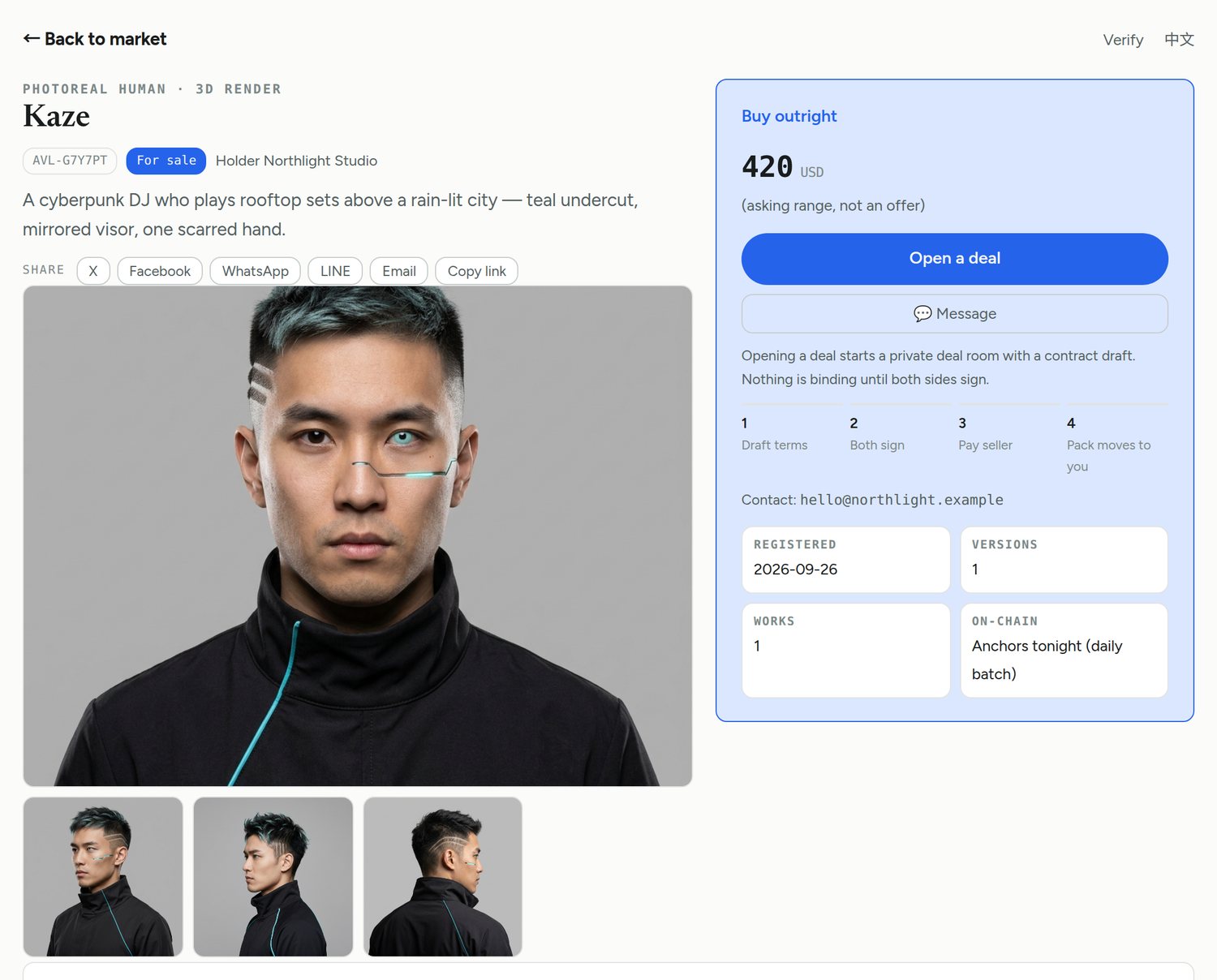
The public page carries identity, visible markers and the anchored record. The full specification text and the platform notes stay private — they are deliverables, and they transfer with the pack when a deal completes.
第 01–03 層
規格是從你手上現有的圖裡讀出來,再由你確認的:輪廓、結構、表面、配色、身分特徵、禁止事項。登記之後,角色會拿到 AVL-XXXXXX 這種格式的登錄編號,規格也會被雜湊成指紋。之後每次修改都登錄成新版本、各有各的指紋,所以「某一天的角色長什麼樣」是拿得出證據的,不用靠記憶。
這一步的意義,是把「我的角色」變成一個有邊界的東西。契約只要用一行指向它就好,不必用三段文字描述,事後再被對方爭執範圍。
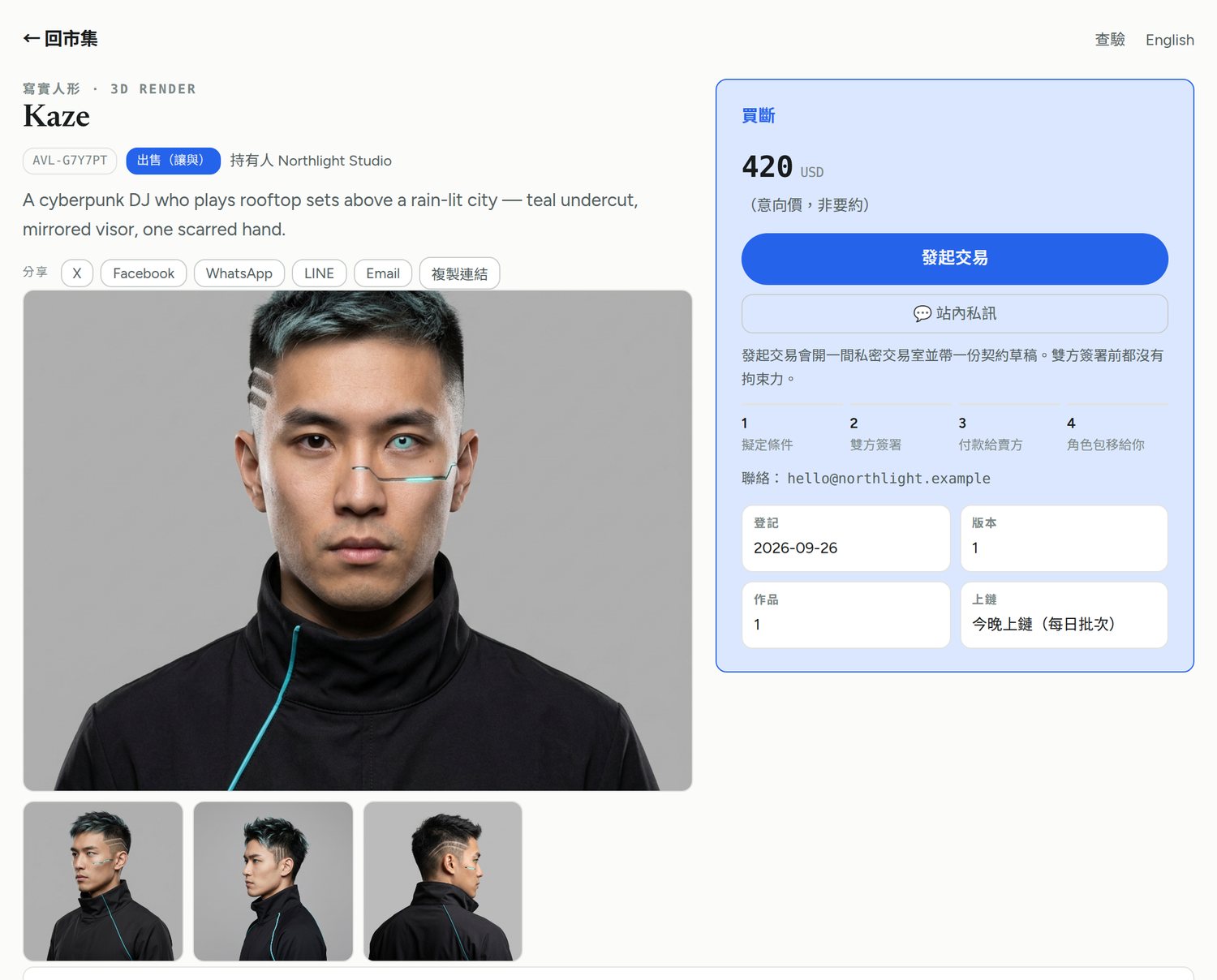
公開頁上有身分、看得到的特徵、上鏈紀錄。規格全文與各平台的 prompt 保持私密,它們是交付物,成交時才隨角色包一起移轉。
Layer 04
A registry that fingerprints a file proves the file existed. It does not connect that file to the character being sold — that connection sits in the registry’s own database, which is precisely the part a buyer cannot check. Half of a provenance claim is missing, and it is the half that matters in a sale.
So the anchored leaf is not the file hash. It is the hash of a small record that names both sides of the relationship:
{
  "v": 1,
  "type": "work_binding",
  "avl_id": "AVL-2BC8GS",
  "spec_hash": "2784f56b25d2ec81…",
  "holder": "u_60a1771e8eeb",
  "work_id": "a30615fb",
  "work_sha256": "a30615fb…089374",
  "media": "image",
  "kind": "upload",
  "rights": "own",
  "claimed_created_at": "2026-03-11",
  "registered_at": "2026-09-04T04:41:12Z"
}
Anyone holding that record can recompute its hash, walk the Merkle path and read the root back off the chain. What that establishes is one sentence long and worth having: this file, bound to this character at this specification version, was registered by this holder on this date.
The records are kept in an append-only registry that is not attached to any account folder. Delete the work, delete the character, close the account — the public check still answers honestly, because an on-chain record cannot be recalled and a registry that pretends otherwise is worth nothing.
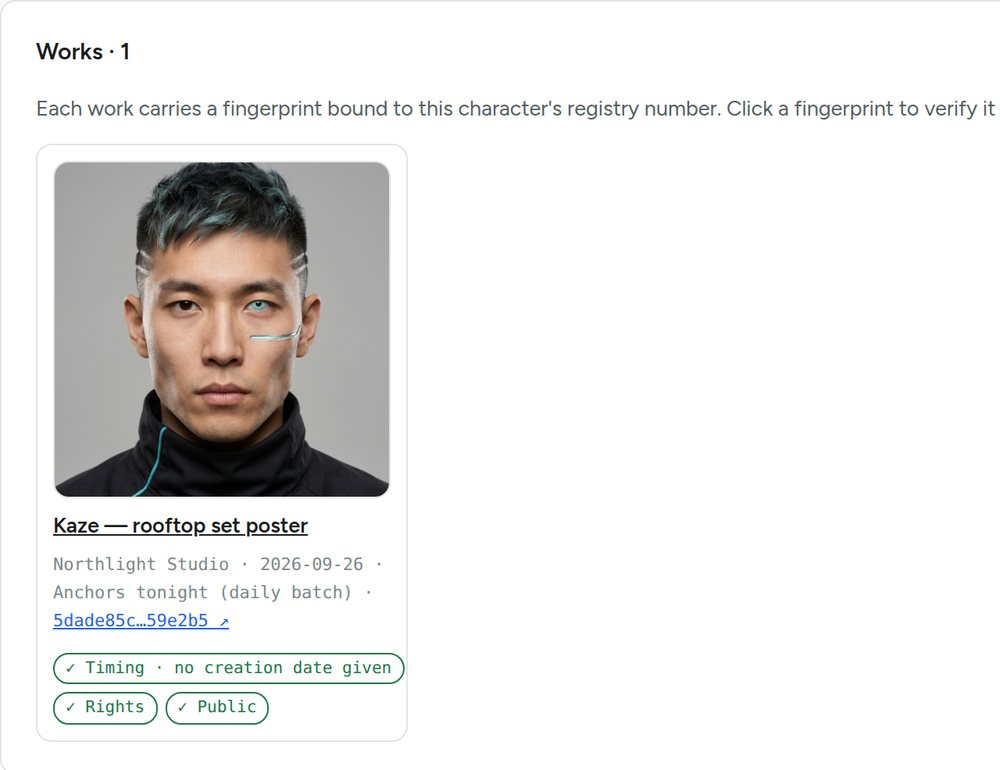
Every work on a character page carries its own fingerprint. Clicking it opens the public check — no account, no sign-in.
第 04 層
只對檔案算指紋的登錄簿,證明的是「這個檔案存在過」。它沒有把檔案和被賣的那隻角色連起來,那個連結只存在登錄簿自己的資料庫裡,而那正是買家查不到的部分。來歷主張少了一半,而且是買賣裡重要的那一半。
所以上鏈的葉子不是檔案的雜湊,而是一小份同時寫明關係兩端的紀錄,再拿這份紀錄去算雜湊:
{
  "v": 1,
  "type": "work_binding",
  "avl_id": "AVL-2BC8GS",
  "spec_hash": "2784f56b25d2ec81…",
  "holder": "u_60a1771e8eeb",
  "work_id": "a30615fb",
  "work_sha256": "a30615fb…089374",
  "media": "image",
  "kind": "upload",
  "rights": "own",
  "claimed_created_at": "2026-03-11",
  "registered_at": "2026-09-04T04:41:12Z"
}
任何人拿到這份紀錄,都能重算雜湊、沿著 Merkle 路徑走一遍、再從鏈上讀回樹根。它能確立的只有一句話,但這句話值得:這個檔案,在這一天,由這個持有人,綁在這隻角色的這一版規格上。
這些紀錄放在一本只增不刪、不屬於任何帳號資料夾的登記簿裡。刪作品、刪角色、關帳號,公開查驗照樣誠實回答。因為鏈上的紀錄收不回來,而一本假裝收得回來的登錄簿,一文不值。
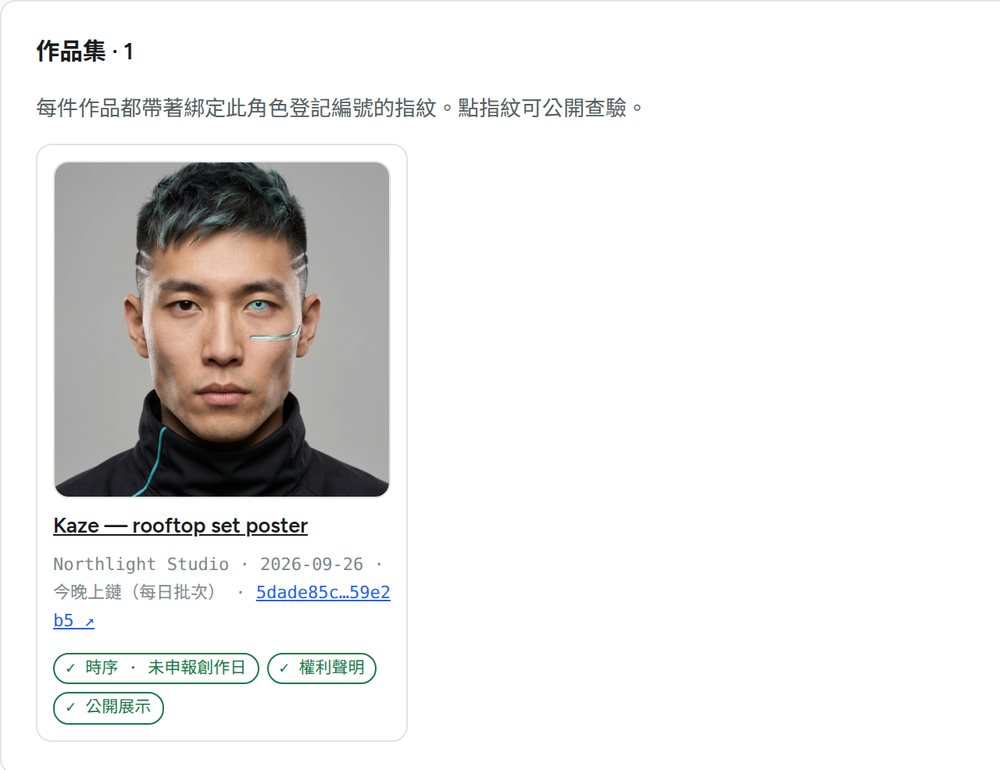
角色頁上每件作品都有自己的指紋。點下去就是公開查驗頁,不用帳號、不用登入。
Evidence
A binding record fixes who said what, and when. It does not, on its own, say why anyone should believe it. So each registered work carries a set of checks that are run separately, recorded separately, and shown separately — because they are not interchangeable and pretending they are is how registries end up meaning nothing.
| Check | What it establishes | Where it applies |
|---|---|---|
| Timing | The work is later than a specific version of the character’s specification. Derivation has to run in that direction. | Everything |
| Attribution | How the work was presented when it was published — title, channel, date — read out of the snapshot frozen at registration. | Links |
| Rights | What the holder declared: own work or licensed. Music is asked twice, once for the composition and once for the recording. | Everything |
| Public | How long the work has been visible on the character’s public page. | Listed characters |
Each result is one of four states, and the difference between the last two is the whole point: pass, partial, not met, not applicable. A link whose page could not be fetched and an uploaded file that has no page to fetch are not the same finding.
None of the four judges what the work looks like. The platform does not compare a song, a video or an image against the character and decide whether it "matches"; a character can change outfits, styles and framing, and a machine score for that would only raise doubts nobody asked for. What is recorded is when, by whom and how.
There is deliberately no total, no score out of ten, and no single green tick. Independent facts cannot be averaged; averaging them is just a way of hiding which one is missing.
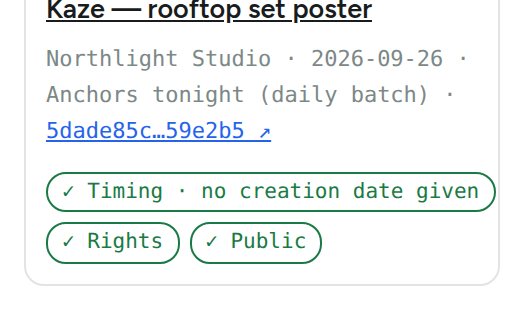
One work, separate answers. Dashed outlines are checks that have not been run; a check that does not apply to a work, such as attribution for an uploaded file, is not shown as failed.
Each check is its own record with its own fingerprint, anchored in the same nightly batch. That is what makes the ladder usable over time: a channel can be re-verified next quarter, an attribution snapshot re-taken, an older work topped up later — and none of it touches the binding record that was already frozen. Evidence added afterwards is stamped with the date it was actually collected, not backdated to the registration.
佐證
綁定紀錄固定了誰、哪一天、說了什麼;但它本身不會告訴別人為什麼該相信。所以每件登錄作品都掛著一組檢查,各自執行、各自記錄、各自顯示。因為它們不能互相代替,而假裝可以代替,正是讓登錄簿失去意義的方式。
| 檢查 | 確認什麼 | 適用範圍 |
|---|---|---|
| 時序 | 作品晚於角色規格的某個特定版本。衍生只能往這個方向發生。 | 全部 |
| 歸屬 | 作品發表時的樣子:標題、頻道、日期,從登記當下凍結的快照讀出來。 | 連結 |
| 權利 | 持有人聲明的內容:自己的作品,或已取得授權。音樂會問兩次,曲一次、錄音一次。 | 全部 |
| 公開 | 作品在角色公開頁上公開掛了多久。 | 已刊登的角色 |
每項結果是四種狀態之一,而後兩種的差別就是重點所在:通過、部分、未通過、不適用。一條抓不到頁面的連結,和一個本來就沒有頁面可抓的上傳檔,是兩回事。
四項裡沒有一項在評斷作品長什麼樣。平台不會拿一首歌、一支影片或一張圖去和角色比對、判定「像不像」;角色本來就會換裝、換畫風、換取景,機器打出來的分數只會製造沒人要的懷疑。記錄的是什麼時候、由誰、怎麼發表的。
這裡刻意沒有總分、沒有十分制、沒有一個綠色勾勾。各自獨立的事實不能平均,平均只會把「缺哪一項」藏起來。
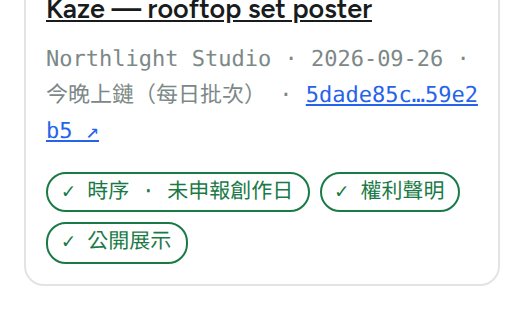
一件作品,各自的答案。虛線外框是還沒跑的檢查;不適用的項目(例如上傳檔案沒有「歸屬」可查)不會被當成沒過。
每項檢查都是一筆有自己指紋的獨立紀錄,跟著同一個夜間批次上鏈。這樣這套檢查才能長期使用:管道下一季可以重驗、歸屬快照可以重抓、舊作品可以事後補做,而且都不會動到已經凍結的綁定紀錄。事後補的佐證,蓋的是實際蒐集的日期,不會回填成登記日。
Channels
Measurement is useless for the things most character creators actually publish: a music release, a video the character does not appear in, an Instagram post. For those, the strongest available evidence is not what is in the frame, it is who published it.
So control of a channel is verified at the character level. Declare the account or the domain, take the one-time code, put it in the bio, the channel description or any post; a domain can serve it at /.well-known/openstela.txt. The platform fetches the page once, compares, and records the result. Only the code counts. It contains a random part, so placing it proves control of the page — a plain link back to the character page does not, because a fan page can do that too.
Works published on a verified channel then carry that evidence automatically. The wording on the record is deliberately narrow: it proves the marker was present on that page at that time, not permanent ownership of the account, which is why it expires and is worth re-running before a sale. Some platforms block anonymous fetching; those are reported as unverifiable rather than quietly passed.
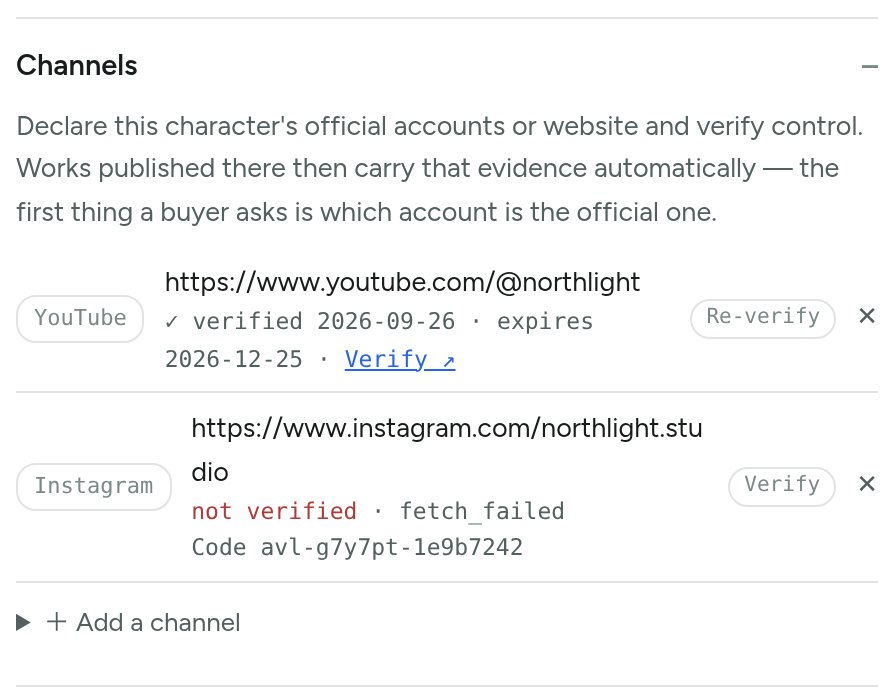
Verified and unverified look different on purpose. A channel that could not be checked says so.
管道
角色創作者實際發表的東西,多數沒辦法拿來量:一張音樂發行、一支角色沒露臉的影片、一則 Instagram 貼文。對這些作品來說,最有力的證據不在畫面裡,而是「誰發表了它」。
所以管道的控制權是在角色這一層驗證的。你聲明一個帳號或網域,拿到一組一次性驗證碼,放進簡介、頻道說明或任何一則貼文;網域可以放在 /.well-known/openstela.txt。平台抓一次頁面、比對、記錄結果。只認驗證碼,因為它有隨機段落,放得上去就代表你控制了那個頁面。單純放一個回連到角色頁的連結證明不了什麼,粉絲頁也放得了。
之後在已驗證管道上發表的作品,會自動帶著這項證據。紀錄上的用字刻意收得很窄:它證明「那個標記當時出現在那個頁面」,不證明帳號永久歸你所有。所以它會過期,出售前值得重跑一次。有些平台會擋匿名抓取;遇到那種情況會回報「無法驗證」,而不是悄悄放行。
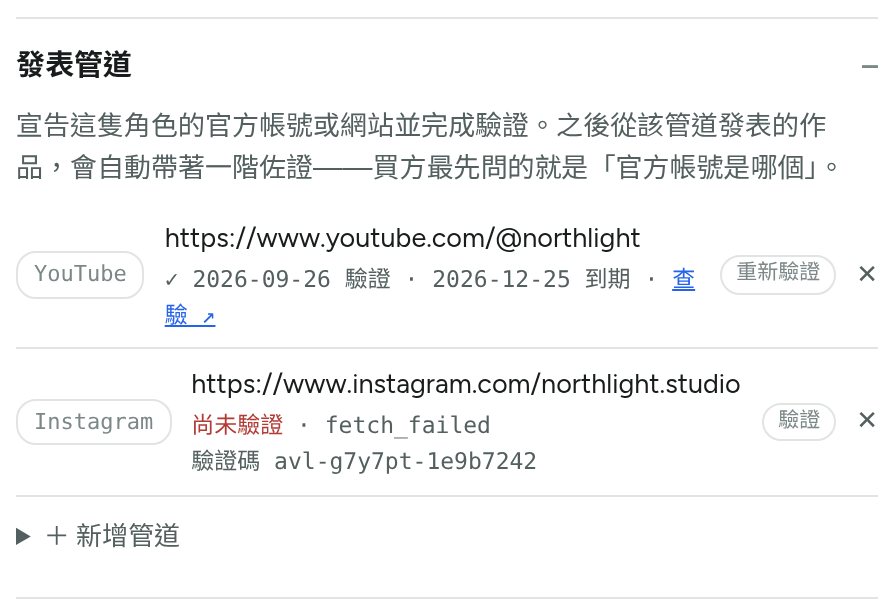
已驗證和未驗證刻意長得不一樣。查不到的管道,會自己說明查不到。
The contract
Opening a deal creates a private room with a draft in it: an assignment or an exclusive licence, in English, from a template written for this kind of asset. Fill in the parameters, switch optional clauses on or off, rewrite any clause you disagree with. Three things then behave differently from a document passed back and forth by email.
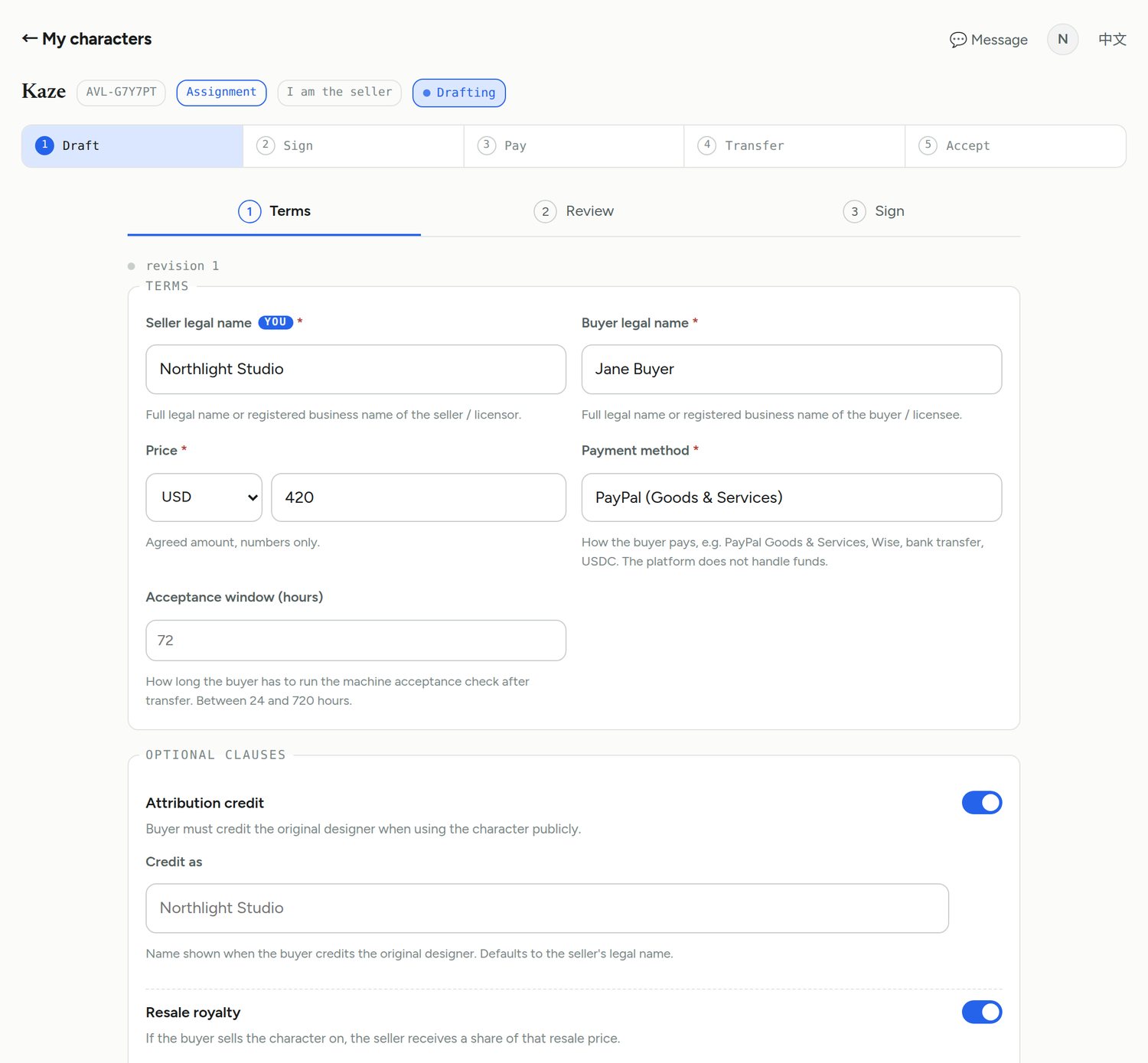
Drafting runs in three steps: the terms, then the whole contract to review, then signatures. Fields the platform fills are shown but locked.
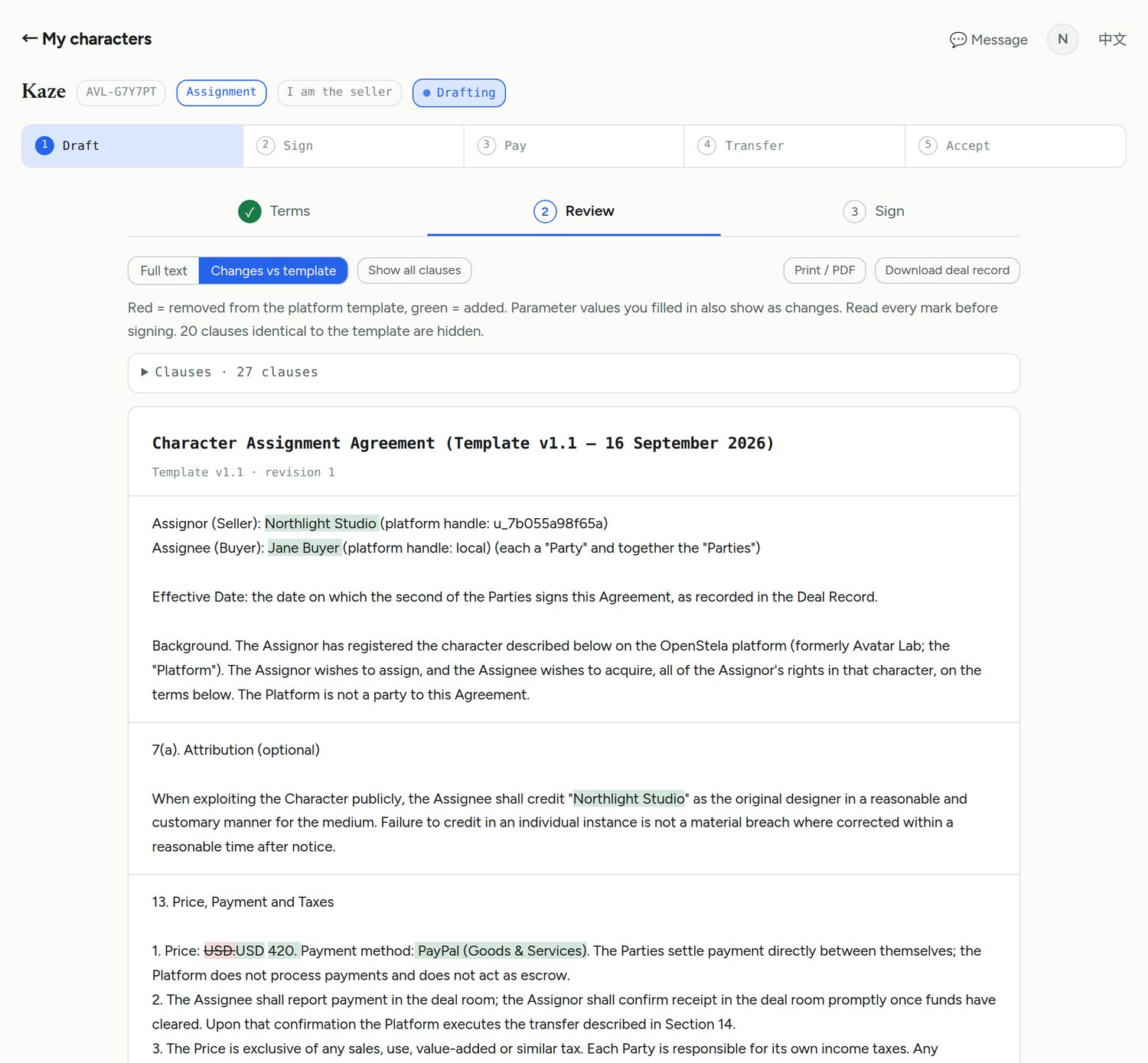
The same draft as a redline. Every value either party filled in, and every clause either party rewrote, is marked.
The standard templates (v1.0) are drafted in English and are the governing text; the Chinese versions are provided for understanding only. They are written for creator-to-creator deals with United States law in mind — the writing requirement of 17 U.S.C. § 204(a), electronic signature under E-SIGN and UETA, a VARA waiver, a right-of-publicity warranty, mutual indemnities, and New York law by default, all editable in the builder. They are templates, not legal advice. Whatever the two parties end up signing is their agreement, not ours — the platform is not a party to it.
契約
開啟交易時會建立一間私密的交易室,裡面已經有一份草約:讓與或專屬授權,英文,來自為這類資產撰寫的範本。你填參數、開關選用條款、改寫任何不同意的條文。接下來三件事,和用 email 傳來傳去的 Word 檔不一樣。
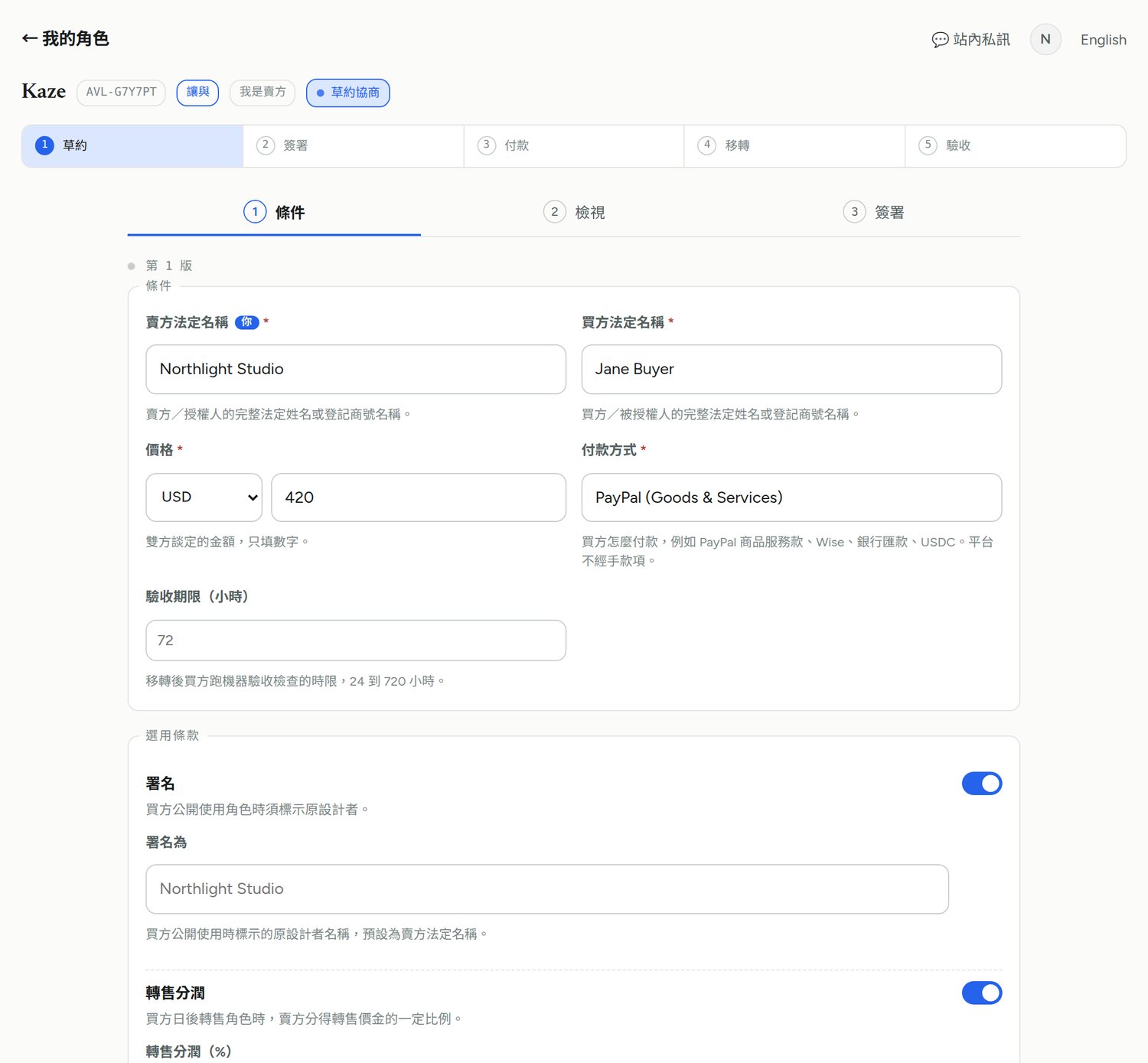
草擬分三步:先填條件,再看整份契約,最後簽署。平台填的欄位看得到,但鎖住。
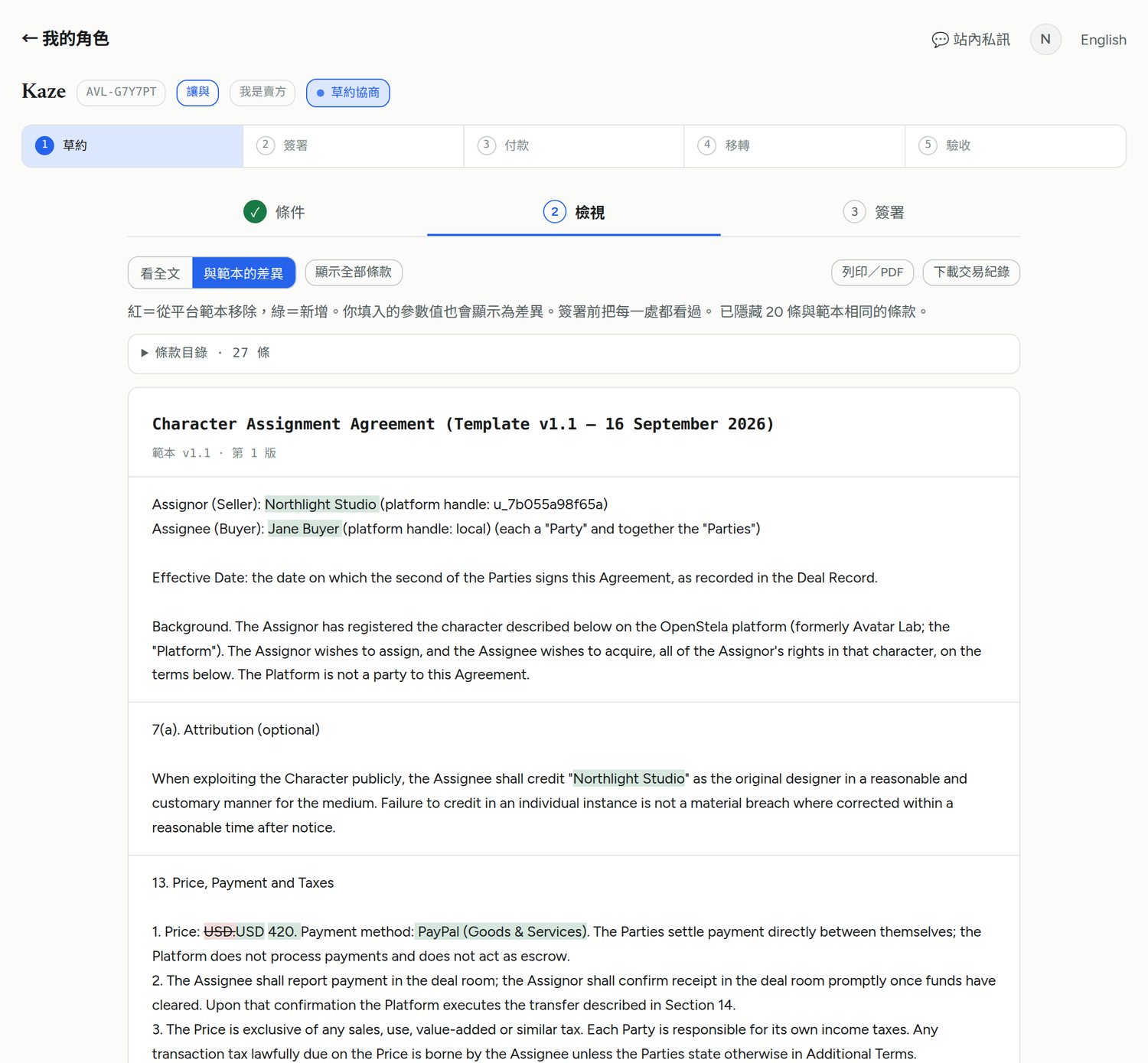
同一份草約的紅線版。任一方填的每個值、改的每條條款都標出來。
標準範本(v1.0)以英文起草、以英文為準,中文版只供理解。範本是為創作者之間的交易、以美國法為基礎撰寫:17 U.S.C. § 204(a) 的書面要件、E-SIGN 與 UETA 下的電子簽章、VARA 拋棄、公開權擔保、相互補償,以及預設紐約法,全部都可以在編輯器裡修改。它們是範本,不是法律意見。雙方最後簽的是他們自己的契約,不是我們的;平台不是契約當事人。
Delivery
The moment both signatures land, two things are frozen: the text, and the file list. The character pack is snapshotted — every path, every file hash — and locked. Until the deal completes or is cancelled the seller cannot edit the specification, delete a work, remove an image or re-list the character. Not by convention: those requests are refused.
When the seller confirms the money has arrived, the seller pays the platform's deal fee — 5% of the agreed price, minimum US$15 (US$3 for a non-exclusive licence), the only charge on the whole platform — and the platform moves the pack. In an assignment it is a move, not a copy: the specification, the reference set, the source images, the registered works and the registry record leave the seller’s account and arrive in the buyer’s, with the transfer appended to the character’s history. The file list is compared before and after, and against the snapshot taken at signature, so “complete delivery” is a comparison rather than an opinion. An exclusive licence instead delivers a copy with no registry number of its own, and marks the original as licensed so it cannot be sold or licensed again while that lasts.
The buyer then has an acceptance window — its length is one of the negotiated parameters — to check what arrived. Silence at the end of it counts as acceptance. A dispute inside it freezes the deal for review, and a review can reverse the transfer: the pack goes back, and the reversal is written into the history rather than erased from it.
| What has to happen | Doing it by hand | In the deal room |
|---|---|---|
| Get a usable contract | Find a template, or a lawyer. Days, and a cost that often exceeds the price of the character. | Drafted when the room opens, from the template for the mode you picked. |
| Agree on one text | Word files by email. Two people end up holding different documents and nobody can prove which one was agreed. | Both sign the same SHA-256. Any edit clears both signatures, so there is only ever one agreed text. |
| Know what was delivered | A zip and good faith. Whether the seller kept a copy is unanswerable. | The file list is frozen at signature and checked file by file at transfer. |
| Leave a record | Usually none. The evidence is a chat log. | Contract and transfer fingerprints are anchored that night, on the same root as the character. |
The platform’s own steps — drafting, saving terms, both signatures, transfer with the file check — take about 30 ms in total (median of five runs, local measurement, tools/measure_deal_timing.py). That number is not the point, and it is not how long a sale takes: what a sale waits for is two people deciding. The point is that none of the waiting is paperwork.
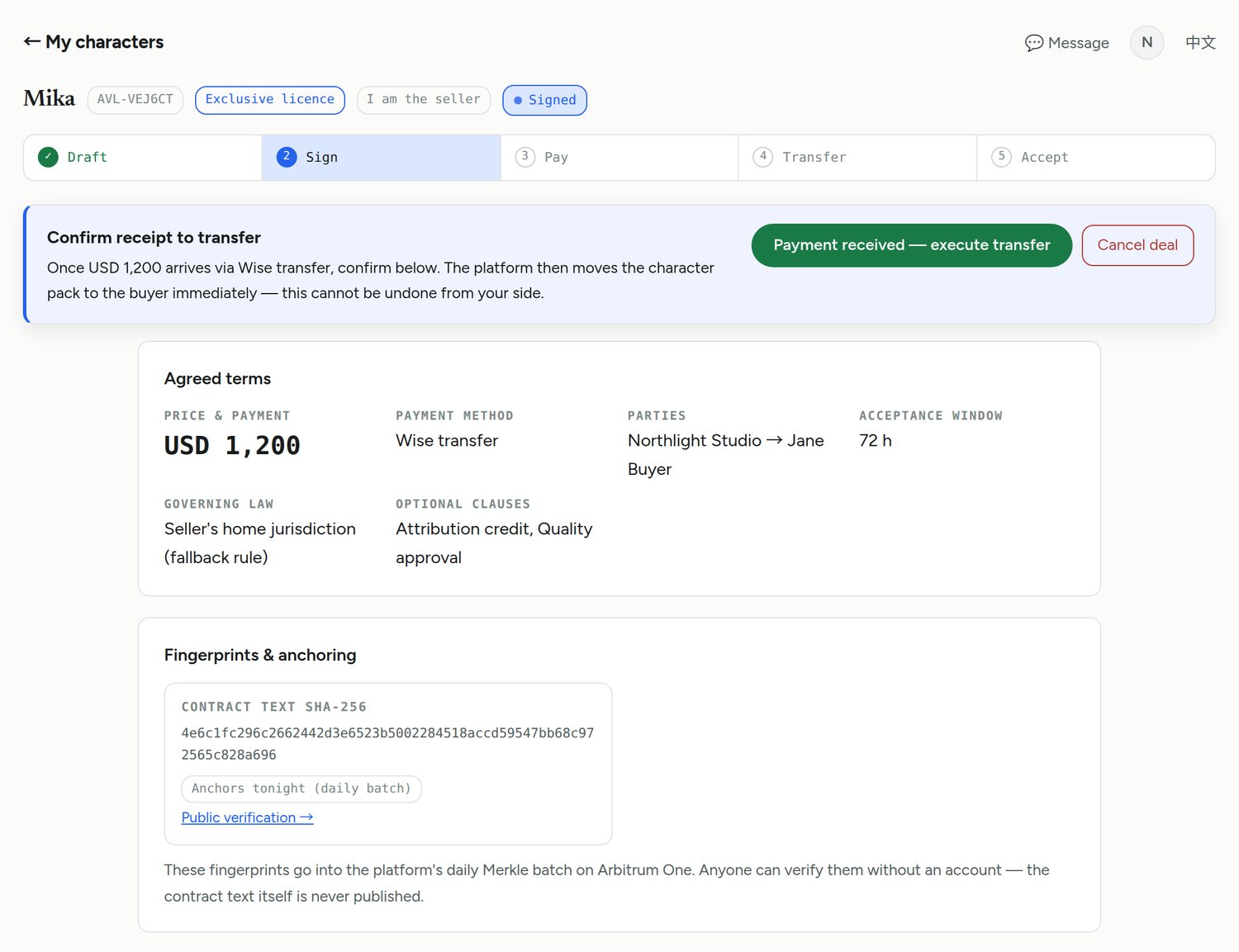
After signature the room stops being an editor and becomes a record: agreed terms, the contract fingerprint, the anchoring status, and one clear next action.
交付
雙方簽名落下的那一刻,兩樣東西凍結:文本,和檔案清單。角色包會被快照,每個路徑、每個檔案的雜湊都記下來,然後鎖住。在交易完成或取消之前,賣家不能改規格、不能刪作品、不能移除圖片、也不能重新刊登。這不是約定,那些操作會直接被拒絕。
賣家確認款項到帳之後,先付平台的成交手續費(成交價 5%、最低 US$15(非專屬授權最低 US$3),這是整個平台唯一的收費),平台隨即搬移角色包。讓與是搬走,不是複製:規格、參考圖集、來源圖、登錄作品和登錄紀錄離開賣家帳號、抵達買家帳號,移轉事件附加到角色的歷史上。搬移前後的檔案清單,都會和簽署時的快照比對,所以「有沒有完整交付」是一次比對的結果,不是一種看法。專屬授權則是交付一份沒有自己登錄編號的副本,原件標記為已授權,期間內不能再賣、也不能再授權給別人。
接著買家有一段驗收期,長短是協商參數之一,用來檢查收到的東西。期滿沒有意見就視為驗收。期內提出爭議,交易會凍結、交付審查;審查可以把移轉復原,角色包搬回去,復原也會寫進歷史,而不是抹掉。
| 要完成的事 | 自己來 | 在交易室裡 |
|---|---|---|
| 拿到能用的契約 | 找範本,或找律師。要幾天,而且費用常常高過角色本身的價格。 | 開交易室當下就依所選型態的範本草擬完成。 |
| 對同一份文本定案 | Word 檔用 email 來回。最後兩邊手上是不同的檔案,而且誰也證明不了哪一份才是談定的。 | 雙方簽同一枚 SHA-256。任何修改都會清掉兩邊的簽名,所以永遠只有一份談定的文本。 |
| 確認交付了什麼 | 一個 zip 加上互信。賣方有沒有留副本,這個問題沒有答案。 | 檔案清單在簽署當下凍結,移轉時逐檔比對。 |
| 留下可查的紀錄 | 通常沒有,證據是一段聊天紀錄。 | 契約與移轉的指紋當晚上鏈,與角色同一個樹根。 |
平台自己那幾步——草擬、儲存條件、雙方簽署、移轉並逐檔比對——合計約 30 毫秒(5 輪中位數,本機量測,tools/measure_deal_timing.py)。這個數字不是重點,也不等於一筆交易要多久:交易真正在等的是兩個人做決定。重點是,等的那段時間裡沒有一分鐘花在文書上。
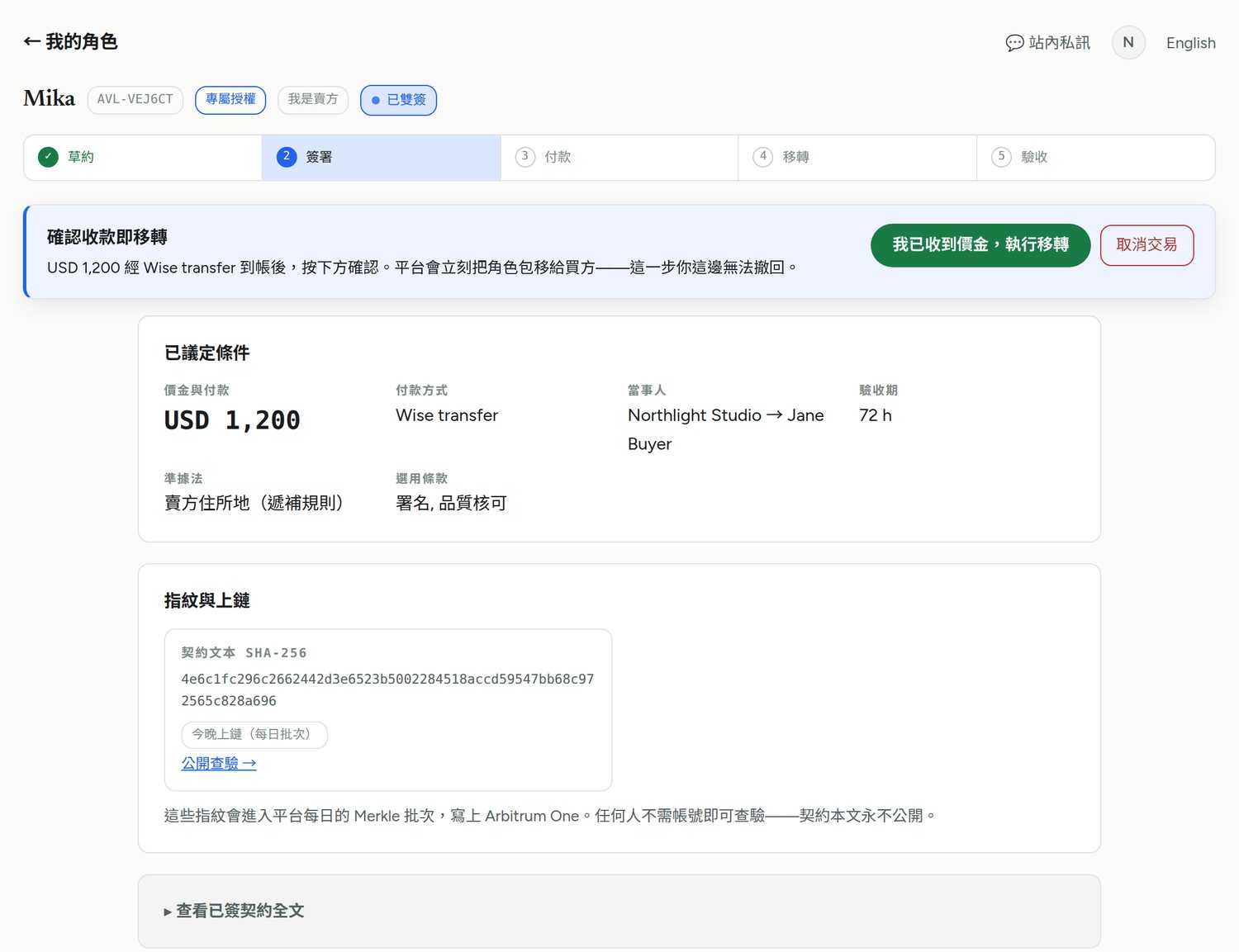
簽署之後,交易室不再是編輯器,而是一份紀錄:議定條件、契約指紋、上鏈狀態,還有一個明確的下一步。
The check
Every fingerprint on this platform — a specification version, a work binding, a signed contract, a transfer event — can be pasted into a public page that answers in three separate layers, because they are worth different amounts.
Collapsing those three into one green tick would be easier to design and worse to rely on. The check runs without an account, and it keeps working if this company does not.
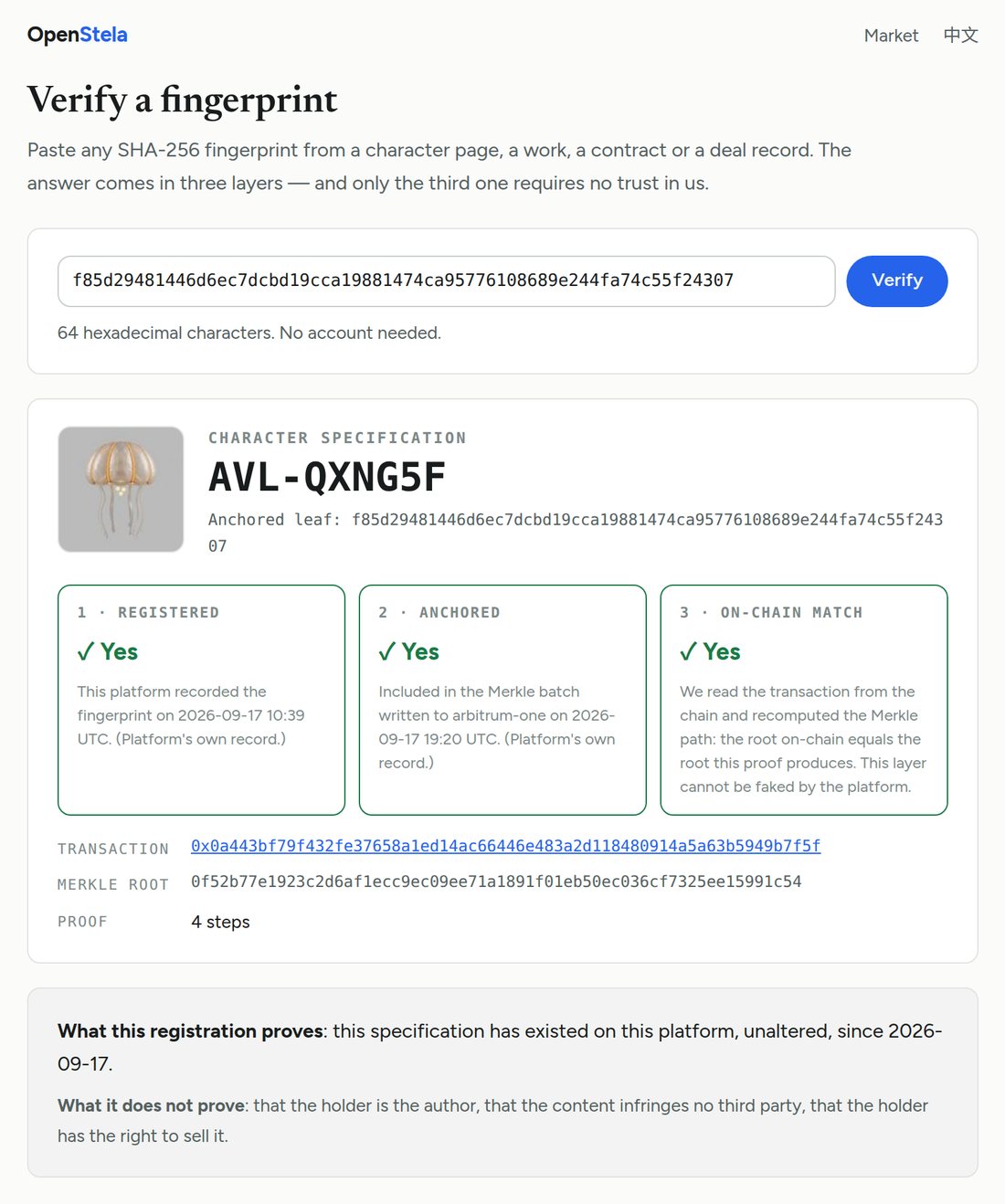
A real record, checked live. Paste any fingerprint at app.openstela.io/verify.
查驗
這個平台上的每一枚指紋,不管是規格版本、作品綁定、已簽契約還是移轉事件,都可以貼進同一個公開頁面。它會分三層回答,因為三層的價值不一樣。
把三層縮成一個綠色勾勾,畫面會比較好看,但可靠度會下降。查驗不需要帳號;就算這家公司哪天不在了,這一層照樣成立。
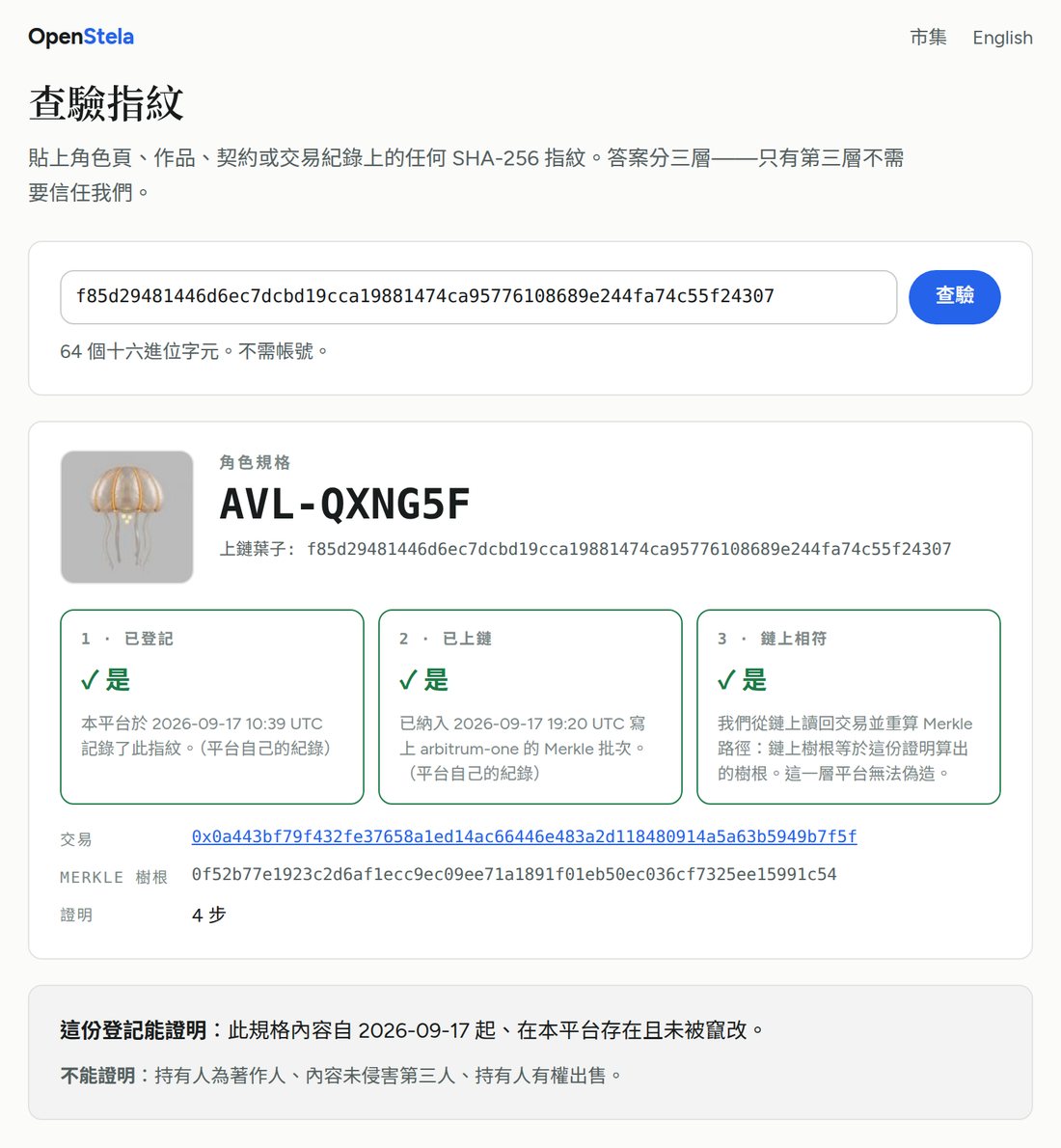
一筆真實紀錄,即時查驗。任何指紋都可以貼到 app.openstela.io/verify。
Boundaries
Nothing on this page is legal advice, and it describes mechanisms rather than outcomes. The economics of the same design — which costs actually fall, and which stubbornly do not — are set out in what a character sale actually costs.
邊界
這一頁沒有任何內容是法律意見;它描述的是機制,不是結果。同一套設計在經濟面的效果,哪些成本真的降了、哪些還是很貴,寫在賣一隻角色實際要花多少。
Start
A registration is useful long before a sale: it dates the specification, accumulates a version history, and gives every work you publish something to be bound to. Once registered, the character is on the market as “not for sale” unless you mark it private; putting a price on it is a switch you flip afterwards, per character.
